

Today’s students, self-learners, and anyone chasing growth are balancing more than ever before. They’re juggling what to focus on: courses or assignments, internships or side hustles, mental health or social connections, all while battling the constant ping of notifications and the pressure to stay “productive.”
But here’s the truth: Busy doesn’t always mean progress. More often than not, it’s organized chaos, disguised as productivity, masking what truly drives results. That overwhelming checklist might feel like action, but without direction, it’s just motion.
The good news? There are simple tools and processes that can help you prioritize and get clear on what actually deserves your time and attention.
One of the most effective tools out there?
The Eisenhower Matrix – a no-nonsense, easy-to-use framework that helps you cut through the noise and focus on what truly matters. It’s not about doing more. It’s about doing what matters more, so you can learn smarter, not harder.
In this blog, we break down how this powerful tool can help students reclaim their time, sharpen their focus, and finally ditch the stress of trying to “do it all.”
What is the Eisenhower Matrix?
The Eisenhower Matrix is so-called because of President Dwight D. Eisenhower, famously quoted with the phrase, “What is important is seldom urgent, and what is urgent is seldom important.” The Eisenhower Matrix separates tasks into four quadrants (Qs) based on two questions:
Is it important? Is it urgent? A breakdown of its makeup is outlined below:
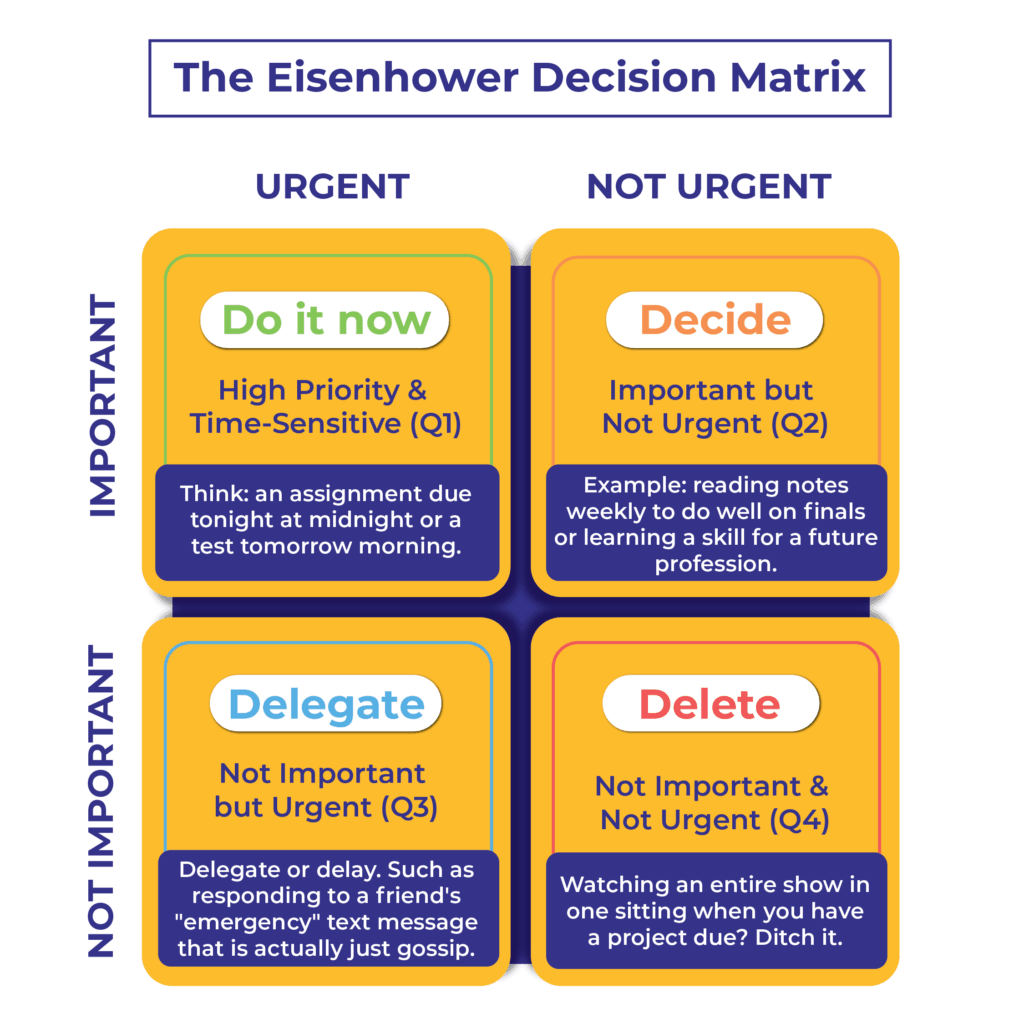
It is a 2×2 grid: one dimension for urgency, one for importance. It is easy to start with and forces you to confront what is worth your time.
Ready to get started? Below is a systematic approach:
- List Everything: Write down everything you must do; homework, group work, club meetings, even “check social media for memes.”
- Sort Them: Put every task in a quadrant. Be brutal, what is critical to your growth? What’s mere noise?
- Do: Deal with Q1 immediately, delay Q2 later, cut down Q3 (refuse it or postpone it), and ignore Q4 altogether.
Daily Tip: Take five minutes every morning prioritizing your day.
- Quiz today? Q1.
- Researching long-term projects? Q2.
- Ringing phone? Like Q3 or Q4.
Weekly Tip: Spend one hour every Sunday afternoon planning out Q2 projects or tasks like making a reading schedule or even rehearsing a habit. These are the low-profile victories that add up over time.
Examples in Action:
Student:
- Q1 = Working on an essay due tomorrow.
- Q2 = Studying Python in a future class.
- Q3 = Responding to a group text.
- Q4 = Scrolling social media
Self-Learner:
- Q1 = Finishing a tutorial for a work deadline.
- Q2 = Practicing every day to become an expert in graphic design.
- Q3 = Responding to a non-urgent email.
- Q4 = Playing games all night.
Common Learner Mistakes to Avoid
Picture replacing late-night cramming with a peaceful, purposeful routine where you’re one step ahead. That’s the strength of putting critical things first. However, the matrix is not foolproof, this is where students stumble:
- Overloading Q1: Tackling all work as a five-alarm fire. No, that email is not calling for an immediate response.
- Q2 procrastination: Putting steady prep off until it reaches a Q1 crisis. Procrastination is the killer.
- Misjudging “Urgent”: Your ringing phone is not as urgent as your study block—don’t let it fool you.
- Forgetting to Tweak It: Life shifts. Revisit your matrix weekly to keep it aligned with your goals.
Getting Started??
You don’t have to use fancy equipment, just a notebook, a Google Doc, a template or an app like Notion.
Keep it simple.
- Begin with a rapid audit: Log 15 minutes of your day. Where is your time actually going? Social media? Procrastinating about things that don’t matter? Use that data to fill in your quadrants.
- Establish the practice: Dedicating five minutes each day to organizing tasks equates to achieving a week of clarity.
- Gradually, this routine becomes instinctive, allowing individuals to discern what deserves their attention and what constitutes mere distraction.
Let’s face it, we’ve all caught ourselves in the cycle of doing everything and burning out.
Busyness is not a virtue; it’s a bad habit. And as with any bad habit, you can quit it. The Eisenhower Matrix is your escape: a simple yet mighty tool to cease responding to every little emergency and begin owning your time. It’s about separating the urgent from the important so you can channel more energy into learning, developing, and pursuing what really matters.
At HiQmah, we’re all about freeing you from the mess and helping you work smarter. Prioritize better. Reduce your mental load. Focus on long-term growth—not just box-ticking. We guide learners in effective task management using proven techniques that save time, lower stress, and boost actual learning. Because when your brain isn’t bogged down, you can concentrate, retain more, and even enjoy the process again.
Ready to stop being busy and start being intentional? Let HiQmah show you how. Your time matters. Your goals are worth it. Let’s make your efforts count.